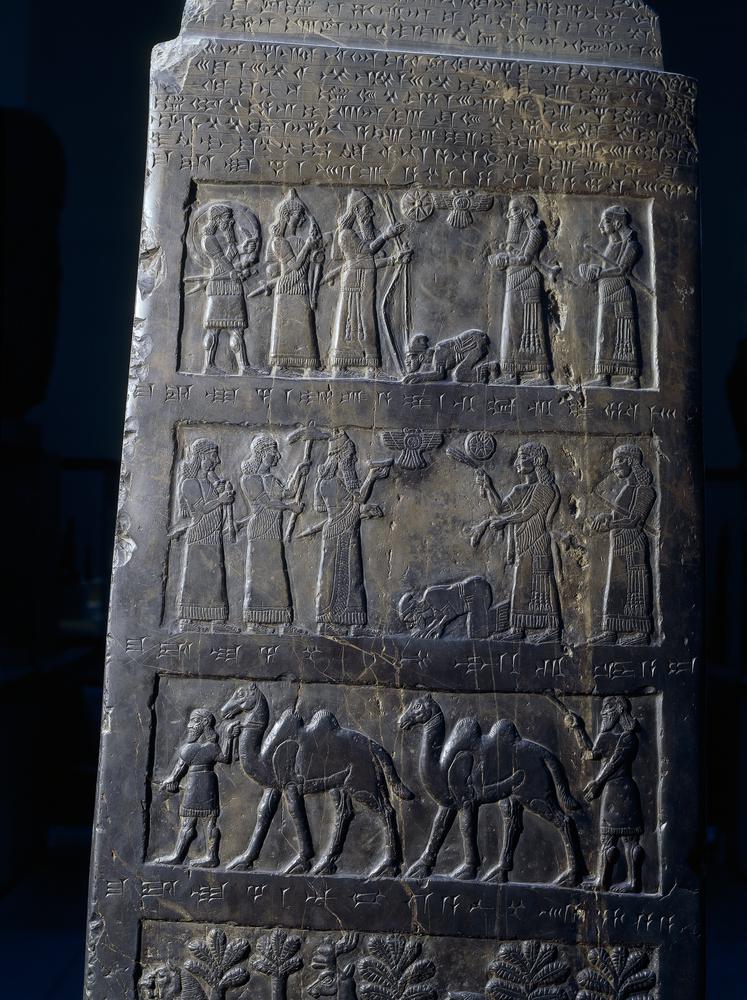
Black Obelisk of Shalmaneser III
In the mid-9th century BC, the Assyrians under Shalmaneser III waged war against the northern kingdom of Israel.
This was the Battle of Qarqar, dated to 853 B.C.
Shalmaneser’s campaign reflected the rising power of Assyria, a ruthless conquering force from Mesopotamia.
And not surprisingly, Shalmaneser was victorious and forced the king of Israel to pay tribute to him.
The Black Obelisk of Shalmaneser is a remarkable stone monument discovered in 1846 by Austen Henry Layard in his excavations at the Assyrian capital of Nimrud, now in northern Iraq.
One panel depicts a man paying homage and presenting gifts to the Assyrian king.
The accompanying inscription identifies the man as “Jehu, son of Omri.”
Jehu and Omri are two kings in the Bible. Jehu followed Omri as a ruler of the northern kingdom of Israel.
Previously their existence had to be taken on faith. Now they have solid historical attestation.
Moreover, on the Black Obelisk we don’t merely read about Jehu; we see him.
Never before had archaeologists witnessed a depiction of what an ancient Israelite king looked like.
The Black Obelisk is one artifact among many dozens that authenticates the historicity of the Bible.
More here: https://a.co/d/0gs62qXC