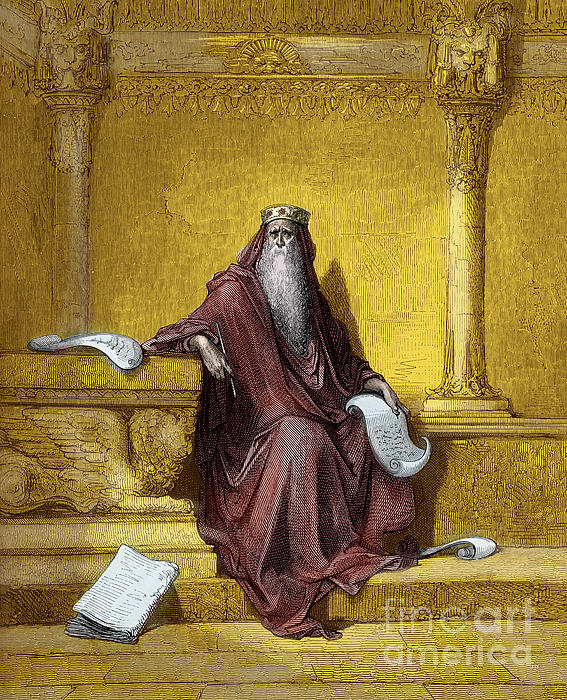
Donkey dung and King Solomon
What can fossilized donkey dung tell us about the reach of King Solomon’s rule in the 10th century B.C.?
The Bible depicts Solomon as a rich, wise and powerful king, ruling over a unified Israelite kingdom.
For centuries, skeptics and “minimalists” said Solomon’s kingdom was small and inconsequential.
Then copper mines were discovered in the Timna Valley in the far south of Israel.
Copper mines are a potential source of wealth and international trade.
But who had control of these mines?
The skeptics and minimalists offered a plausible answer: Egypt! Egypt was the great power in the Near East in the 10th century B.C.
But donkey dung found in the area sent archaeologists, led by Erez Ben-Yosef of Tel Aviv University, in a different direction.
The dung was surprisingly well-preserved, and there was also a large amount of it.
Scholars analyzed the seeds and pollen in the dung, and could tell from its ingredients that the donkey was raised in or near Jerusalem.
How could they possibly know that? Because evidently the donkey’s diet consisted of vegetation characteristic of Jerusalem.
A single donkey. A single deposit of donkey poop. Yet the implications are quite profound.
The presence of dung at the copper site, from a Jerusalem donkey, suggests that Jerusalem controlled the mines, not Egypt.
The copper mines were most likely part of Solomon’s kingdom.
And the donkey dung offered a clue not just to the affluence of that kingdom, but also to its reach, far south of Jerusalem to the bottom tip of Israel.
My new book is out this week. Order here:
https://a.co/d/012bbEZ1