WHERE DID THE EMPIRES GO?
One standard skeptical or minimalist claim, sustained over many decades, was that the royal kingdoms of King David and Saul must be mythical, because there were powerful empires in antiquity and Israel was certain to be subjugated by one of them.
The skeptics said the biblical narrative about David and Solomon’s reign—and especially the account of Solomon as a wise and powerful ruler of international repute—must be wildly exaggerated, if not completely made up.
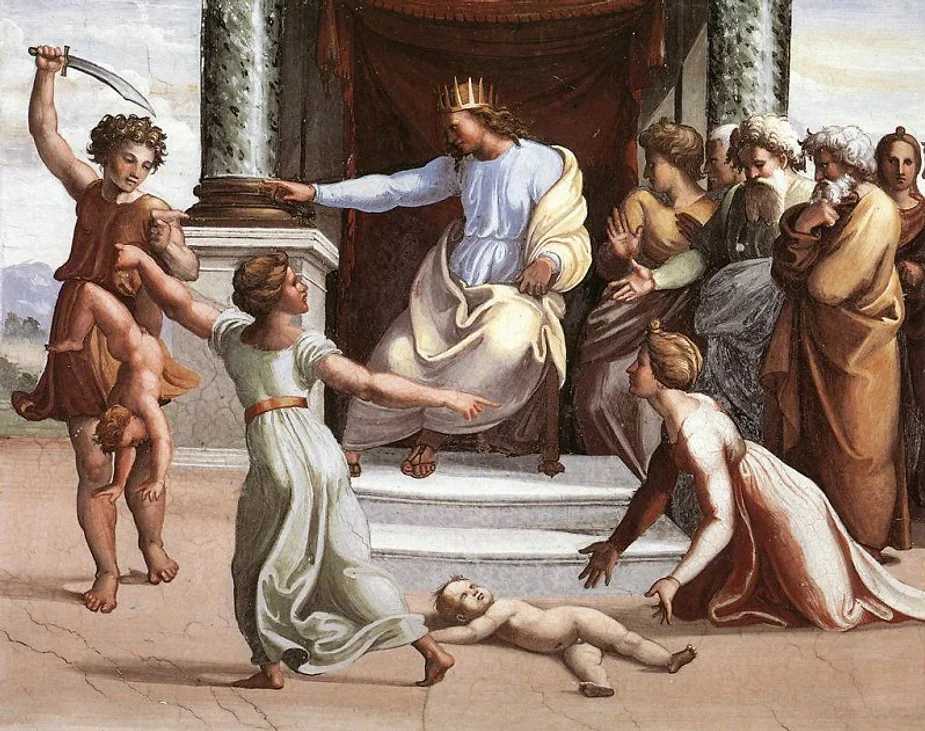
The painting below depicts a biblical story about the wisdom of Solomon.
Surely, the skeptics said, these rulers if they existed would be under the sway of the great powers of antiquity: the Hittites, the Egyptians, the Babylonians or the Mycenaean Greeks.
But David and Solomon ruled around the 10th century B.C. And as it turns out, the great empires of antiquity had subsided by then, with some of them only reviving later, when they were in a position to invade and occupy Israel.
The Hittite empire disintegrated between 1200 and 1150 B.C.
During this period Egypt lost its Asian possessions and entered a period of terminal decline.
Babylon was sacked in 1155 B.C., not to rise again until much later.
The civilization of the Mycenaean Greeks also imploded, and Greece entered a dark age that lasted through the 7th century B.C.
In sum, there was gap or interregnum for a couple of centuries before new empires, notably the Assyrian and neo-Babylonian, rose to dominance and tormented Israel.
It was during this 200 year interregnum that Israeli has its royal period and reached its apogee or high point under King Solomon.
Mystery solved! The skeptical position collapsed. The biblical narrative is no longer historically implausible, and there is now strong extra-biblical archaeological evidence for its historicity.
More here: https://a.co/d/0cOWWYwy